

Instead of paying into Social Security, you are likely enrolled in a FICA alternative plan. This mandatory retirement savings vehicle is designed to provide you with a retirement benefit in place of Social Security. This guide will demystify these plans, explain how they work, and show you how to leverage them for a secure financial future. We’ll dive into the mechanics, compare them to traditional Social Security, and provide actionable tips to ensure your retirement is on track.
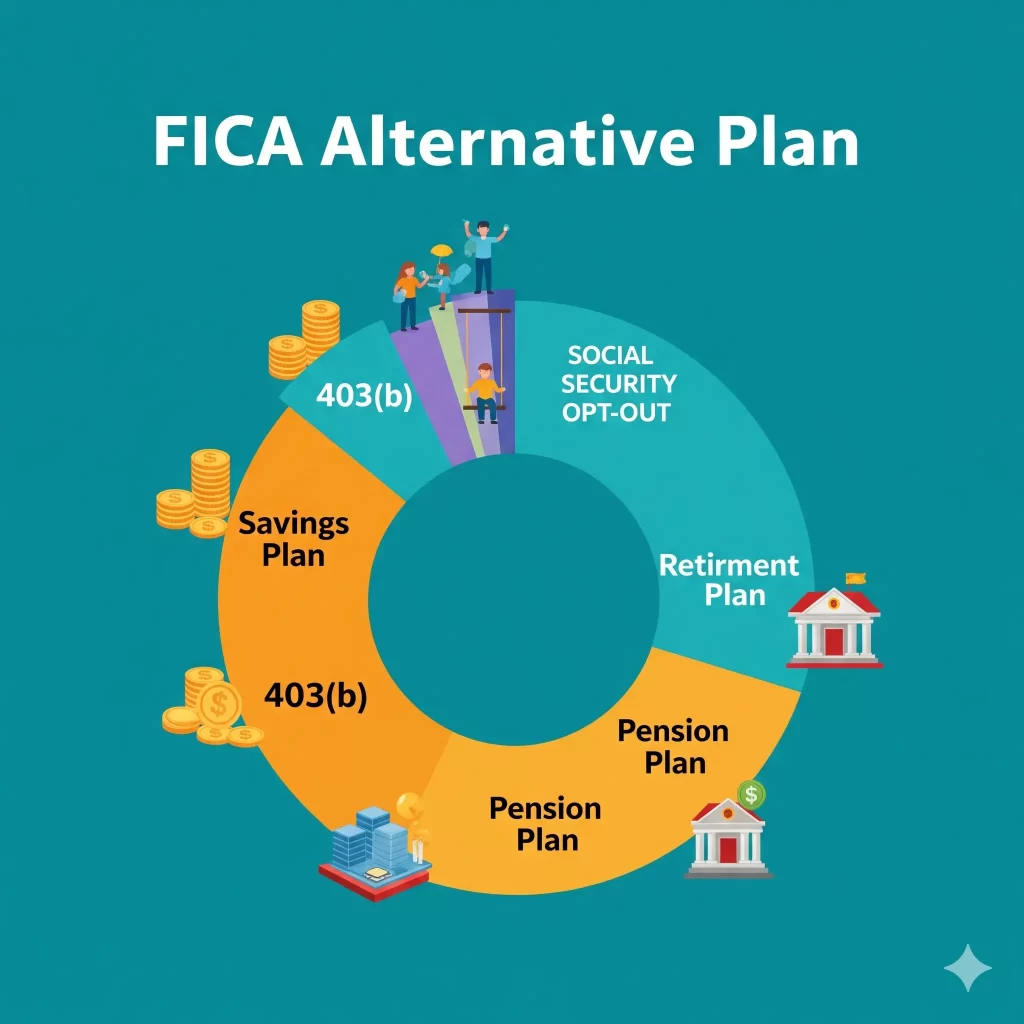
FICA Alternative Plan
If you’re a state, local government, or public school employee, you may have noticed something different about your pay stub: no Social Security tax. For many, this can be confusing, as the Social Security deduction is a standard part of the American paycheck. The truth is, this isn’t a mistake—it’s part of a different system.
What is FICA and Who Doesn’t Pay It?
To understand a FICA alternative plan, you first need to understand FICA itself. FICA stands for the Federal Insurance Contributions Act, which mandates the federal payroll taxes that fund both Social Security and Medicare. In 2024, the FICA tax rate is 7.65% of your earnings, with your employer matching that amount for a total of 15.3%.
For a specific group of public-sector workers, however, a unique exemption applies. Under Section 218 of the Social Security Act, state and local governments can enter into agreements with the Social Security Administration (SSA) to exclude their employees from Social Security coverage. The key condition for this exemption is that the government entity must provide its own mandatory retirement plan for all of its employees who would otherwise be covered by Social Security. This is where the fica alternative retirement plan comes in.
This exemption applies to employees in many state and local governments, public schools, and public universities who are part of a qualifying retirement system that provides its own pension or retirement plan.
Understanding the FICA Alternative Plan
A FICA alternative plan is a mandatory, tax-deferred retirement savings vehicle that serves as a direct replacement for the Social Security portion of the FICA tax. Its purpose is to ensure that employees who are not covered by Social Security still have a systematic way to save for retirement.
The most common type of FICA alternative plan is a 401(a) plan. While similar in name to a 401(k), a 401(a) is a different kind of qualified retirement plan used by governmental and non-profit organizations. It serves as the primary mechanism for the mandatory contributions that replace the Social Security tax. The funds are automatically deducted from your paycheck and invested in an individual account that belongs to you.
Key characteristics of these plans:
- Mandatory Contributions: A fixed percentage of your pre-tax salary is automatically deducted. This rate typically mirrors or exceeds the 6.2% that would have gone to Social Security.
- Tax-Deferred Growth: The money you contribute is not taxed until you withdraw it in retirement. This allows your earnings to grow without being reduced by annual taxes.
- Employer Contributions: Your employer may also contribute to the plan, although this is often optional and can be based on a match or a fixed contribution rate.
Your retirement benefit from a FICA alternative plan is based on the total amount of contributions and the investment returns in your individual account. This gives you direct control over your financial future, but also comes with the responsibility of managing your investments and understanding the plan’s rules.
FICA Alternative Plan vs. Social Security: A Side-by-Side Comparison
The core difference between these two systems is one of control and risk. While Social Security offers a predictable, government-guaranteed benefit, a FICA alternative plan offers the potential for greater returns but places more responsibility on the individual.
| Feature | FICA Alternative Plan (e.g., 401(a)) | Social Security |
| Contribution Method | A fixed percentage of your salary (e.g., 7.5%) is automatically deducted and deposited into an individual account. | A fixed 6.2% of your salary is deducted and goes into a collective government fund. |
| Benefit Formula | Benefits are based on your total contributions and the performance of your investments. The more your investments grow, the larger your retirement fund. | Benefits are calculated using a complex, non-negotiable formula based on your lifetime earnings and age at retirement. |
| Risk & Control | High control, higher risk. Your retirement fund is a direct reflection of your investment choices. The risk of market downturns is borne by you. | Low control, low risk. The benefit is guaranteed by the government, regardless of market performance. You have no control over how the funds are invested. |
| Vesting | Your own contributions are always 100% yours. Employer contributions often have a vesting schedule, meaning you must work for a certain number of years to fully own the funds. | You become fully vested in benefits after accumulating 40 work credits, typically 10 years of work. |
| Portability | Highly portable. When you leave your job, you can roll your vested funds into a new employer’s plan or a personal IRA. | Not portable. Your benefits are tied to your work history and stay within the federal system. You cannot move them. |
Exportar para as Planilhas
The key takeaway from this comparison is that a FICA alternative plan gives you the power to grow your retirement savings, but with that power comes responsibility. Your benefit is not guaranteed; it depends on your active participation and investment choices.
The Core Mechanics of a FICA Alternative Plan (401(a))
Since the 401(a) plan is the primary vehicle for FICA alternatives, it’s important to understand its key rules and features.
Mandatory Employee Contributions
Your employer will set a mandatory contribution rate, which is a percentage of your gross salary. This rate is usually designed to be comparable to or slightly higher than the Social Security tax (6.2%). These contributions are deducted automatically from each paycheck before taxes, which means they reduce your taxable income for the year. The money is then placed in your individual retirement account, where it can begin to grow tax-deferred.
Vesting Schedules Explained
Vesting is a critical concept for employer contributions. It’s the process by which you gain full ownership of the money your employer puts into your account. The two most common types of vesting schedules are:
- Cliff Vesting: You are not vested at all until you complete a specific number of years of service, typically three years. Once you hit that three-year mark, you become 100% vested in all the employer contributions. If you leave before this date, you lose all of the employer’s money.
- Graded Vesting: You gradually gain ownership of the employer’s contributions over time. For example, you might become 20% vested after two years of service, 40% after three years, and so on, until you are 100% vested after six years.
It’s crucial to know your plan’s vesting schedule. If you plan to leave your job, knowing whether you are fully vested can determine whether you forfeit a significant portion of your retirement savings.
Rules for Distributions and Withdrawals
Like most qualified retirement plans, there are rules regarding withdrawals. If you take a distribution from your FICA alternative plan before age 59½, the withdrawal is generally subject to a 10% early withdrawal penalty, in addition to regular income taxes.
However, a key advantage of these plans is their portability. When you leave your job, you can choose to:
- Roll over the funds into an IRA (Individual Retirement Arrangement).
- Roll over the funds into a new employer’s qualified retirement plan (if they accept rollovers).
- Leave the money in the existing plan.
This flexibility allows you to consolidate your retirement savings and maintain a clear picture of your total retirement nest egg.
Important Financial Planning Steps for Non-Covered Employees
While a FICA alternative plan is a great starting point, it’s often not enough to secure a comfortable retirement. Here’s what you need to do to take full control of your financial future.
- Supplement with Additional Savings: Many government employers offer additional voluntary retirement plans, such as a 457(b) plan or a 403(b) plan. These plans allow you to contribute additional pre-tax dollars to your retirement savings. By maxing out these voluntary plans, you can significantly boost your retirement fund. [internal link to ‘401a vs 403b’].
- Actively Manage Your Investments: In a FICA alternative plan, your retirement fund’s growth depends on your investment choices. Don’t simply set it and forget it. Regularly review your investment portfolio, consider your risk tolerance, and rebalance your assets as needed to ensure your money is working for you.
- Be Aware of the Windfall Elimination Provision (WEP): If you have worked a job where you paid into Social Security and are now in a FICA-exempt position, be aware of the WEP. This provision can significantly reduce your Social Security benefit if you also receive a pension from a non-covered job. [external link to ‘Social Security WEP Fact Sheet’].
By taking these steps, you can transform your mandatory FICA alternative plan from a simple savings vehicle into a powerful foundation for a prosperous retirement.
Frequently Asked Questions (FAQ)
Is a FICA alternative plan mandatory?
Yes. If your employer has a FICA alternative plan in place under a Section 218 agreement, all eligible employees are required to participate. You cannot opt out to pay into Social Security instead.
Can I roll my plan over if I change jobs?
Yes. A FICA alternative plan is portable. If you leave your job, you can roll your vested balance over into a new employer’s retirement plan or a personal IRA.
Does this plan cover my Medicare?
No. The FICA alternative plan only replaces the Social Security portion of the FICA tax. You are still required to pay the Medicare portion (1.45%) on all your earnings. This ensures you remain eligible for Medicare benefits at retirement age.
How do I know if I’m in a FICA alternative plan?
The easiest way to tell is to check your pay stub. If you do not see a deduction for “Social Security,” “OASDI,” or “FICA-SS,” you are most likely in a FICA alternative plan. Your employer’s human resources department can provide you with the specific details of your plan.
Conclusion: Taking Control of Your Retirement
A FICA alternative plan is a vital part of the retirement landscape for a specific group of public employees. While it may seem different, it offers distinct advantages, including greater control over your investments and a portable retirement fund that you can take with you from job to job.
The key to a secure retirement is to not just rely on the mandatory contributions but to be proactive. By understanding how your plan works, supplementing your savings with other voluntary plans, and actively managing your investments, you can build a robust retirement fund that provides the financial freedom you deserve. Your future self will thank you for taking the time to learn and plan today.

Empowering you to master your money with confidence and clarity. On this channel, we break down personal finance—from budgeting basics and saving smarter to debt-free strategies and practical investing—all in easy-to-understand language.
Expect weekly deep dives into real-life financial questions, step-by-step tutorials, and expert insights that make money topics approachable and actionable. Whether you’re building emergency savings, paying off loans, or planning for the future, you’re in the right place to get informed, empowered, and financially confident.