
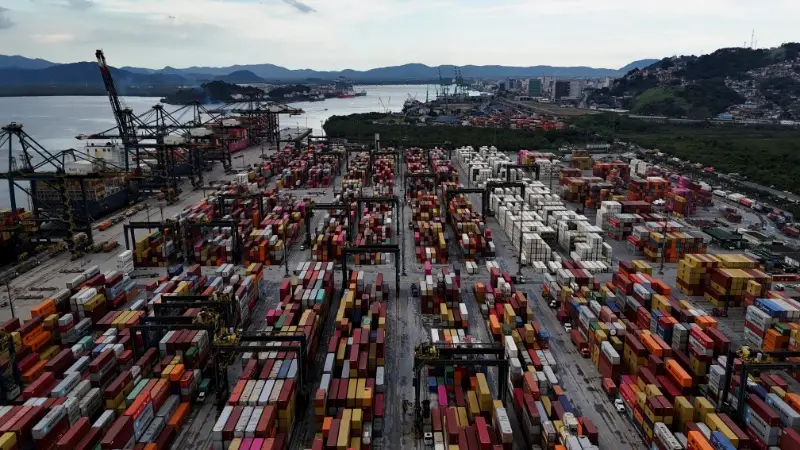
Brazil’s trade balance for March revealed a surplus of US$ 6.405 billion, a figure that, while positive, fell below the financial market’s projections. This outcome, announced by the Secretariat of Foreign Trade (Secex) of the Ministry of Development, Industry, Trade, and Services (MDIC), is a key indicator of the country’s economic performance and its integration into the global marketplace. The reported surplus was achieved with total exports reaching US$ 31.603 billion and imports totaling US$ 25.199 billion.
The market had anticipated a more robust surplus, with the median estimate in the Projeções Broadcast survey pointing to US$ 7.55 billion. This divergence between actual results and market expectations often signals shifts in economic momentum or unforeseen external factors influencing trade flows. For context, February’s trade surplus stood at a more modest US$ 4.208 billion, highlighting a sequential improvement but not enough to meet the heightened expectations for March.
The range of market estimates for March’s surplus was notably wide, spanning from US$ 5.9 billion to US$ 8.5 billion, underscoring the inherent uncertainty in forecasting such economic indicators. These variations can be attributed to a multitude of factors, including global commodity prices, geopolitical events, domestic policy changes, and currency fluctuations. The final figure of US$ 6.405 billion sits within this range, but on the lower end of the more optimistic forecasts.
Analyzing the Drivers of Brazil’s March Trade Performance
Delving deeper into the components of trade, March witnessed a significant 10% increase in exports compared to the same month in the previous year. This growth was broadly distributed across key sectors. Agriculture, a cornerstone of Brazil’s economy, saw a 1.1% rise in exports, contributing US$ 8.256 billion. The extractive industry, encompassing mining and oil, experienced a substantial surge of 36.4%, bringing in US$ 7.359 billion. The manufacturing sector also showed positive momentum, with exports increasing by 5.4% to reach US$ 15.822 billion.
On the import side, the picture was one of a more pronounced increase, with a 20.1% rise in March compared to the prior year. This surge in imports suggests increased domestic demand or a greater reliance on foreign goods for production and consumption. Within imports, the agricultural sector saw a decrease of 10.2%, totaling US$ 517 million. However, the extractive industry’s imports climbed by 24.1% to US$ 1.171 billion, and the manufacturing sector’s imports expanded by 20.8%, reaching US$ 23.347 billion.
The contrasting growth rates between exports and imports in March are crucial to understanding the trade balance outcome. While exports grew healthily, the faster pace of import growth moderated the overall surplus. This dynamic can be influenced by various factors, including the competitiveness of domestic industries, global supply chain dynamics, and the exchange rate, which affects the cost of imported goods and the price of exported products for international buyers.
Year-to-Date Trade Balance: A Stronger Performance
Looking at the broader picture, Brazil’s trade balance for the first quarter of the year (January to March) has been notably strong. The cumulative surplus reached US$ 14.175 billion, a significant 47.6% increase compared to the same period in the previous year. This robust year-to-date performance indicates underlying strengths in Brazil’s export capacity and its ability to generate positive trade balances over extended periods.
During this first quarter, total exports amounted to US$ 82.338 billion, while imports stood at US$ 68.163 billion. The year-on-year growth in exports for the period was 7.1%. The agricultural sector contributed US$ 17.205 billion, showing a 2.4% increase. The extractive industry proved to be a major driver, with exports rising by 22.6% to US$ 20.816 billion. The manufacturing sector also contributed positively, with a 2.8% increase in exports, totaling US$ 43.864 billion.
Imports, on the other hand, saw a more modest increase of 1.3% from January to March 2026 compared to the same period in 2025. Notably, agricultural imports decreased by 19.9% to US$ 1.379 billion, and imports from the extractive industry fell by 7.4% to US$ 2.772 billion. The manufacturing sector’s imports, however, grew by 2.3% to US$ 63.540 billion. The overall slowdown in import growth, coupled with strong export performance, has significantly boosted the cumulative trade surplus for the year.
Implications for Investors and the Brazilian Economy
The trade balance is a critical component of a nation’s **current account**, which, in turn, influences its **exchange rate**, **inflation**, and overall **economic growth**. A consistent trade surplus generally indicates that a country is exporting more goods and services than it is importing, leading to an inflow of foreign currency. This can strengthen the national currency and make imported goods cheaper, while potentially making exports more expensive for foreign buyers.
For investors, understanding these trade dynamics is paramount. A strong export performance, particularly in key commodities, can signal robust global demand and a competitive domestic production base. Conversely, a significant increase in imports might point to strong domestic consumption or a need for capital goods to fuel future production. The miss in March’s surplus, despite the overall positive trend, warrants attention to identify any emerging headwinds or shifts in market sentiment. Factors such as global economic slowdowns, trade disputes, or changes in commodity prices can all impact Brazil’s trade performance.
The Brazilian government and the Central Bank closely monitor these figures. A persistent trade surplus can contribute to a stronger **real** (Brazil’s currency), which can help in controlling imported inflation. However, an excessively strong currency can also hurt the competitiveness of Brazilian exports. Therefore, the interplay between exports, imports, and the exchange rate is a delicate balancing act for policymakers aiming for sustainable **economic development** and **price stability**.
Navigating Global Economic Uncertainties and Future Outlook
The global economic environment remains a significant factor influencing Brazil’s trade. Fluctuations in commodity prices, particularly for agricultural products and minerals, can have a direct impact on export revenues. Geopolitical tensions and shifts in international trade policies can also create volatility. For Brazil, a diversified export base and strategic trade agreements are crucial for mitigating these risks and ensuring a stable flow of international trade.
The performance of the **industrial sector** in Brazil is also a key determinant of its trade balance. While the extractive industry has shown remarkable growth, the manufacturing sector’s ability to compete on a global scale is vital for long-term export diversification and value addition. Policies aimed at boosting industrial competitiveness, innovation, and **productivity** are therefore essential for sustained economic prosperity.
Looking ahead, analysts will be watching closely to see if the trends observed in March are temporary or indicative of a more sustained shift in trade patterns. The ability of Brazil to capitalize on global demand for its commodities while simultaneously fostering growth in its manufacturing and service sectors will be critical for maintaining a healthy trade balance and contributing to overall **national income** and **foreign exchange reserves**.
The **economic outlook** for Brazil will undoubtedly be shaped by its trade performance, alongside domestic factors such as **interest rates**, **fiscal policy**, and **consumer confidence**. A proactive approach to trade policy, coupled with investments in infrastructure and human capital, will be key to navigating the complexities of the global economy and ensuring continued **financial stability** and **growth**.
The Secretary of Foreign Trade (Secex) plays a pivotal role in collecting and disseminating these crucial economic data. Their timely reports provide the foundation for understanding Brazil’s position in the global trade arena. The figures for March, while below expectations, offer valuable insights into the ongoing economic narrative of Brazil, prompting further analysis into the specific sectors and external factors driving these outcomes. This continuous monitoring and analysis are fundamental for informed **investment decisions** and effective **economic management**.
Frequently Asked Questions (FAQ)
What is a trade surplus?
A trade surplus occurs when a country’s exports exceed its imports over a given period. It signifies a net inflow of goods and services into the country, contributing positively to the balance of payments and potentially strengthening the national currency.
Why did Brazil’s March trade surplus fall below market expectations?
While the exact reasons are complex, it typically indicates that imports grew at a faster pace than anticipated, or exports did not meet higher projections. This could be due to increased domestic demand, higher global prices for imported goods, or specific market conditions affecting Brazilian exports.
How does a trade surplus affect Brazil’s currency (the Real)?
Generally, a trade surplus leads to an increased demand for the national currency as foreign buyers need to purchase it to pay for exports. This can cause the Real to appreciate, making imports cheaper and exports more expensive.
What are the main drivers of Brazil’s exports?
Brazil’s exports are heavily influenced by commodities, particularly agricultural products (like soybeans, corn, and sugar) and minerals (like iron ore and oil). The extractive and agricultural sectors are consistently major contributors to the country’s trade balance.
What is the significance of the extractive industry’s performance in Brazil’s trade?
The extractive industry, which includes mining and oil production, is a critical component of Brazil’s export economy. Strong performance in this sector, driven by global demand and commodity prices, can significantly boost the country’s trade surplus and foreign exchange earnings.
How do imports influence the trade balance?
Imports represent an outflow of currency. When imports increase significantly, they can reduce or even eliminate a trade surplus, turning it into a deficit if they outpace exports. High import levels can indicate strong domestic consumption or a reliance on foreign goods for production.
What is the Projeções Broadcast survey?
The Projeções Broadcast is a survey conducted by a financial news service that collects economic forecasts from various market participants, such as banks and financial institutions. It provides a median estimate and a range of expectations for key economic indicators like the trade balance.
What are the long-term implications of trade performance for Brazil’s economy?
Consistent trade surpluses can strengthen a country’s **financial position**, improve its **credit rating**, and provide resources for **investment** and **development**. However, an over-reliance on commodity exports can make the economy vulnerable to price volatility, highlighting the importance of diversifying the export base and fostering value-added industries.

Empowering you to master your money with confidence and clarity. On this channel, we break down personal finance—from budgeting basics and saving smarter to debt-free strategies and practical investing—all in easy-to-understand language.
Expect weekly deep dives into real-life financial questions, step-by-step tutorials, and expert insights that make money topics approachable and actionable. Whether you’re building emergency savings, paying off loans, or planning for the future, you’re in the right place to get informed, empowered, and financially confident.